What Lenders Actually Look At When They Review Your Application
What Lenders Actually Look At When They Review Your Application
Most business owners only see one side of a loan application: filling out forms, gathering documents, and waiting for an answer. On the other side of that application, however, a lender is working through a detailed evaluation designed to answer one important question: how likely is this business to repay the loan?
A business loan application is evaluated through a combination of personal and business credit, cash flow, financial statements, available collateral, owner investment, and the purpose of the requested funding. Understanding this process helps business owners become more prepared and bankable before applying.
Many business owners do not realize how closely lenders examine their financial history, Debt Service Coverage Ratio (DSCR), credit profile, application documents, and overall repayment strategy. Knowing what lenders look for can help you identify potential weaknesses and strengthen your application before they become obstacles.
KEY TAKEAWAYS:
The Five C's of Credit
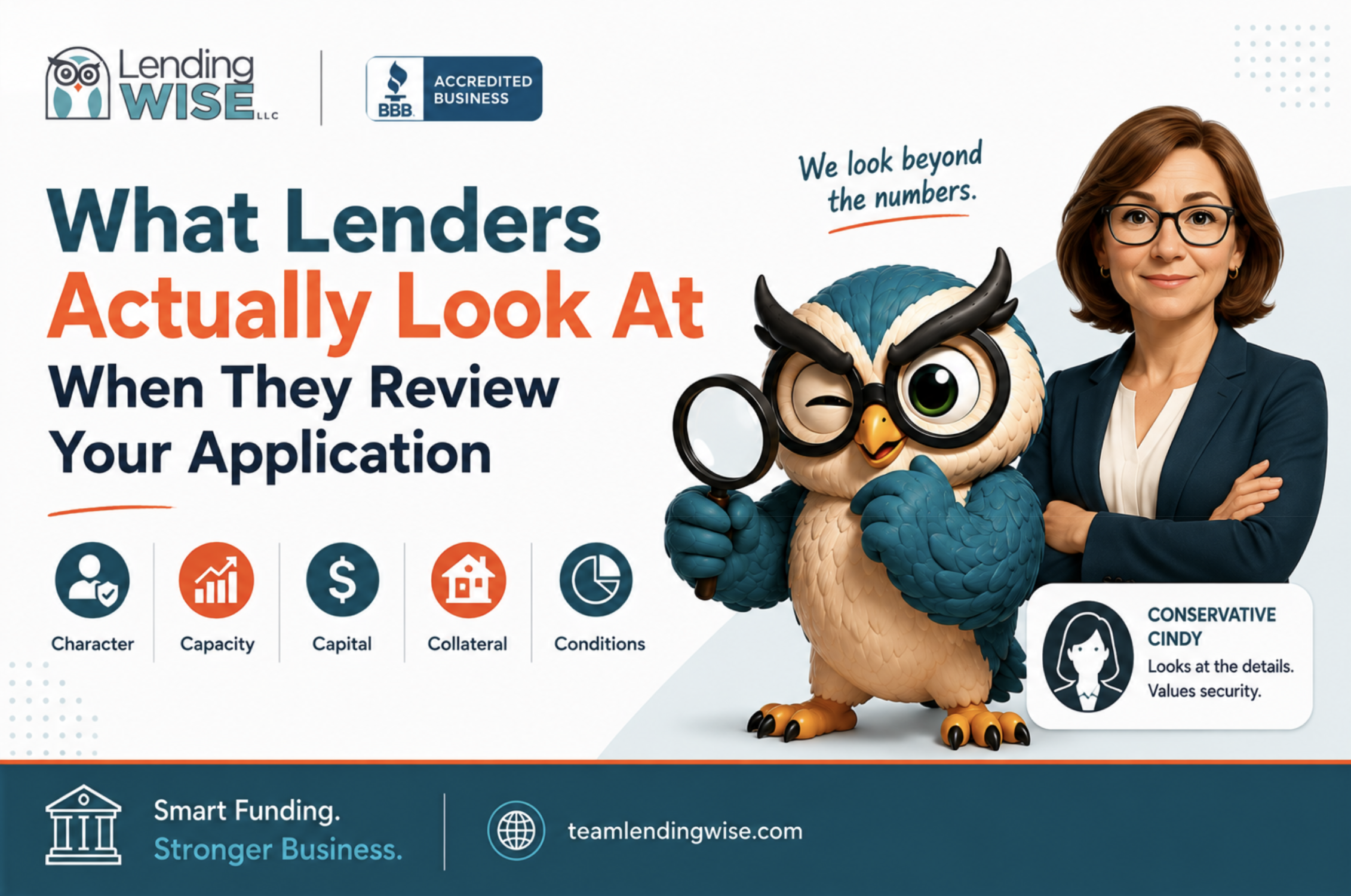
Lenders have used a framework called the Five C's of Credit for decades. It is the foundation of how many commercial loan decisions are made and helps lenders evaluate the overall risk of extending business financing.
Character
This is about you as a borrower.
Lenders review your:
Credit history
Reputation
Track record of paying obligations
Payment behavior
They want to know whether you are the kind of borrower who consistently pays debts and meets financial obligations. Your personal credit score is often the most visible signal in this part of the evaluation.
Capacity
Capacity refers to your ability to repay the loan based on your business's cash flow.
Lenders often calculate your Debt Service Coverage Ratio (DSCR) by dividing your net operating income by your total debt obligations.
A ratio of 1.25 or higher can demonstrate that your business has enough financial cushion to handle a new loan payment in addition to its existing obligations.
Capital
Capital refers to the money you have personally invested in your business.
Lenders want to see that you have skin in the game. A business where the owner has invested significantly may present less risk than one where the owner has contributed little or no capital.
Collateral
Collateral includes assets that can be used to secure a loan.
Depending on the business and financing structure, collateral may include:
Real estate
Equipment
Inventory
Accounts receivable
The more available collateral a borrower has, the more the lender may be able to reduce their risk.
Conditions
Conditions include the purpose of the loan, the current economic environment, and industry-specific factors that could affect the business.
A clear and well-reasoned explanation of how the funds will be used can significantly strengthen this part of your application.
What Lenders Look for in Your Financial Statements
When a lender reviews your financial statements, they are not simply glancing at the numbers.
They are looking for patterns, inconsistencies, trends, and signals that help them understand the financial health of your business.
Profit and loss statement
Lenders want to see revenue trends over the past two to three years.
They may ask:
Is revenue growing, remaining flat, or declining?
Are expenses proportional to revenue?
Is the business generating actual profit after expenses?
Is the business showing revenue without sufficient profitability?
Revenue alone does not tell the full story. Lenders want to understand whether the business is generating enough income to support its obligations.
Balance sheet
Your balance sheet shows what your business owns and what it owes.
Lenders may review your:
Debt-to-equity ratio
Working capital position
Existing liabilities
Available business assets
This helps them understand the overall financial position and leverage of the business.
Tax returns
Personal and business tax returns are typically required for the previous two to three years.
One major concern for lenders is a discrepancy between tax returns and financial statements. If the numbers do not tell the same story, it can raise questions and create additional scrutiny.
Bank statements
Most lenders will request between three and twelve months of business bank statements.
They may review:
Average daily balances
Cash flow consistency
Deposit activity
Whether deposits match reported revenue
Your bank statements provide another layer of verification and help lenders understand how money actually moves through the business.
How Lenders Evaluate Your Personal and Business Credit
Your personal FICO score is often one of the first filters in a business loan decision.
Many SBA lenders want to see a score of at least 650, while some conventional lenders may require higher scores.
But personal credit is not the only score involved.
Your FICO SBSS score is a combined business credit score that many SBA lenders use as a screening tool. A score below 155 may trigger a manual review, which can add time and uncertainty to the application process.
Lenders may also review:
The age of your credit accounts
The mix of credit you maintain
Your payment history
Your credit utilization
Any derogatory marks, including collections, judgments, or bankruptcies
Your credit profile helps lenders understand how you have managed financial obligations over time.
How Your Application Package Can Help or Hurt You
A complete and well-organized business loan application package communicates that you are a serious and prepared borrower.
A disorganized or incomplete package can raise questions before the lender even begins reviewing your numbers.
A strong application package may include:
A clear executive summary explaining the business
A specific purpose for the loan
A clear repayment strategy
Current financial statements
Organized personal and business tax returns
A thoughtful business plan or growth plan
Relevant supporting documents, such as leases, contracts, or equipment quotes
The goal is to make the lender's job easier.
Every additional question a lender has to ask can create another delay—and another opportunity for doubt.
Know How Your Business Measures Up Before You Apply
Understanding what lenders look for is only useful if you understand how your own business measures up.
Before submitting a business loan application, it can be helpful to review:
Your personal and business credit
Your cash flow
Your Debt Service Coverage Ratio
Your financial statements
Your existing debt
Your application package
Your purpose and strategy for the requested funding
Taking the time to identify potential issues before applying can help you address weaknesses and present a stronger, more complete picture to potential lenders.
See Your Business the Way a Lender Will
Most business owners have no idea what happens on the other side of a loan application.
But lenders are following a structured process designed to evaluate risk, repayment ability, and the overall financial strength of your business.
They are reviewing your character, capacity, capital, collateral, and the conditions surrounding your request. They are analyzing your financial statements, examining your credit history, and looking closely at whether your application package tells a clear and consistent story.
Knowing what lenders look for gives you an opportunity to prepare before you apply.
If you want an honest assessment of where your business stands before submitting an application, that is what we do at LendingWISE.
We will look at your credit, cash flow, financials, and application package—and help you understand exactly what a lender is likely to see.

Resources
Quick Link
Learn